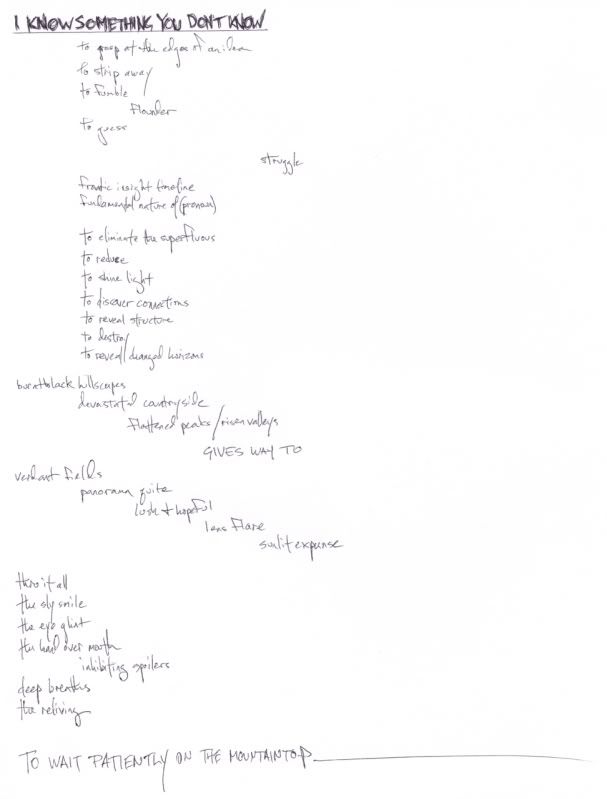
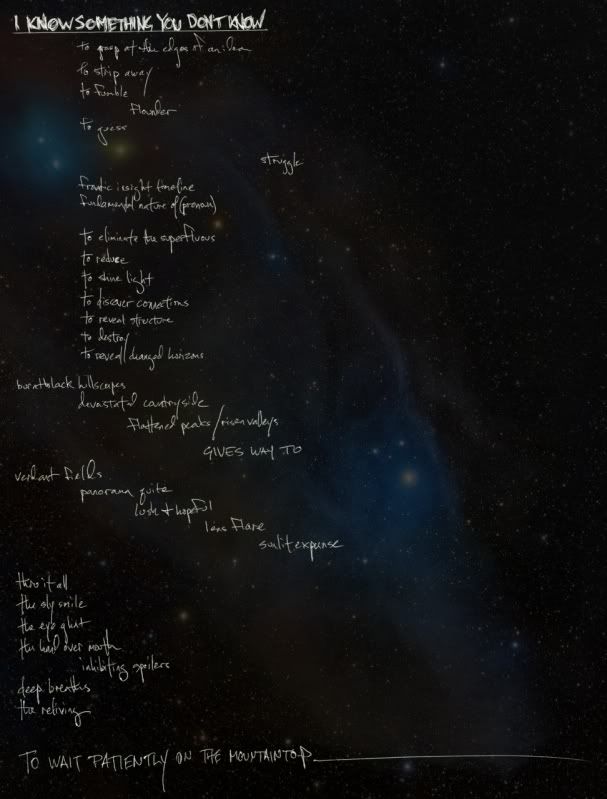
to grasp at the edges of an idea
to strip away
to fumble
flounder
to guess
struggle
frantic insight timeline
fundamental nature of (pronoun)
to eliminate the superfluous
to reduce
to shine light
to discover connections
to reveal structure
to destroy
to reveal changed horizons
burntblack hillscapes
devastated countryside
flattened peaks/risen valleys
GIVES WAY TO
verdant fields
panorama quite
lush and hopeful
lens flare
sunlit expanse
thru it all
the sly smile
the eye glint
the hand over mouth
inhibiting spoilers
deep breaths
the reliving
TO WAIT PATIENTLY ON THE MOUNTAINTOP_____________________________________________________
Friday, July 3, 2009
poetry + new scanner = blogging
I KNOW SOMETHING YOU DON'T KNOW
Sunday, June 14, 2009
what it looks like when elections are stolen outside of Florida
Check out this BBC report from Tehran during public riots/general strike/madness. A government minder of some sort starts to arrest the BBC crew. But the crowd intervenes, beats the apparatchik, and hustles the reporters out of there.
Been doing some crash reading about Iran's recent political history, and man is it ever complicated. But things are falling apart, the falcon cannot hear the falconer. I think most of the world is watching, on pins and needles.
With the clumsy theft of the election, another group of psychotic fundamentalist reactionaries (the Ahmadinejad supporters and the hardline ayatollahs; which latter group may actually be in the process of infighting) is teetering on the edge of being swallowed by a spontaneous popular uprising.
Of course, no government anywhere likes it when the population suddenly starts loudly reconsidering the social contract while gathering in the streets and squares en masse. But the Middle Eastern theocracies tend to be prone to not just boiling over with widespread populist outrage, but unfortunately also the harsh repression by government fanatics, sycophants, and brownshirts that fuels that outrage to begin with.
Anyway, this is the exact situation the following song refers to and was the first thing I thought of when I heard of the censorship and riots in the wake of the Ahmadinejad "landslide"....perhaps it will end peacefully, but from the looks of things (cutting electricity, closing newspapers, arresting opposition leaders, shutting down the phone system, unofficial martial law, etc) it won't. Good luck to the dissenters, you'll need it.
Been doing some crash reading about Iran's recent political history, and man is it ever complicated. But things are falling apart, the falcon cannot hear the falconer. I think most of the world is watching, on pins and needles.
With the clumsy theft of the election, another group of psychotic fundamentalist reactionaries (the Ahmadinejad supporters and the hardline ayatollahs; which latter group may actually be in the process of infighting) is teetering on the edge of being swallowed by a spontaneous popular uprising.
Of course, no government anywhere likes it when the population suddenly starts loudly reconsidering the social contract while gathering in the streets and squares en masse. But the Middle Eastern theocracies tend to be prone to not just boiling over with widespread populist outrage, but unfortunately also the harsh repression by government fanatics, sycophants, and brownshirts that fuels that outrage to begin with.
Anyway, this is the exact situation the following song refers to and was the first thing I thought of when I heard of the censorship and riots in the wake of the Ahmadinejad "landslide"....perhaps it will end peacefully, but from the looks of things (cutting electricity, closing newspapers, arresting opposition leaders, shutting down the phone system, unofficial martial law, etc) it won't. Good luck to the dissenters, you'll need it.
Chaos A.D.
tanks on the streets
confronting police
bleeding the plebs
raging crowd
burning cars
bloodshed starts
who'll be alive?
Chaos A.D.
army in siege
total alarm
I'm sick of this
inside this state
war is created
no man's land
what is this shit?
REFUSE
RESIST
REFUSE
Chaos A.D.
disorder unleashed
starting to burn
starting to lynch
silence means death
stand on your feet
inner fear
your worst enemy
REFUSE
RESIST
REFUSE
RESIST
Thursday, May 28, 2009
new tortoise video
This is fucking cool. Instant classic.
I also found this (an mp3) via this website, which I must have bookmarked ages ago and forgot about. Anyway, that song is even further out there than the one in the video. (I got confused about where there were going with it a couple minutes in; as usual, with patience, badassery is revealed....)
It occurs to me I should read mp3 blogs more often....
I also found this (an mp3) via this website, which I must have bookmarked ages ago and forgot about. Anyway, that song is even further out there than the one in the video. (I got confused about where there were going with it a couple minutes in; as usual, with patience, badassery is revealed....)
It occurs to me I should read mp3 blogs more often....
Tuesday, April 7, 2009
youtube blogging
Bartok/Music for strings, percussion, & celesta
And here's a Youtube clip (no embed link, sorry) of Portishead playing about 2/3 of the new album. I was surprised that they could play this stuff straight off the album like this. I had always assumed their music was built more like most electronic music: nobody plays it first and it gets sort of assembled rather than composed and rehearsed. But I guess I was wrong. At least as far as this album goes, the music is much less dependent on control room tricks than it is on good old fashioned in-the-room noise-making.
Seems to me they created this stuff specifically to be played by musicians live. (Which approach I suspect bears some similarities to Radiohead's approach to In Rainbows.)
They really are a band, which is interesting because I never thought of them as having this rock band-like constitution, with drums, percussion, bass, guitar, keys. (Some instrument switching, but mostly fixed roles.) I wonder if this is how they were in the 90s heyday, although I never saw them live (apart from the PNYC video, but even that had a DJ and a full orchestra), so maybe this is how their stuff was always created and I just didn't realize it. Wouldn't surprise me....
Regardless, the video kicks major ass and the music is a total mindfuck. I got a lot out of watching exactly how they made this or that weird sound.
And here's a Youtube clip (no embed link, sorry) of Portishead playing about 2/3 of the new album. I was surprised that they could play this stuff straight off the album like this. I had always assumed their music was built more like most electronic music: nobody plays it first and it gets sort of assembled rather than composed and rehearsed. But I guess I was wrong. At least as far as this album goes, the music is much less dependent on control room tricks than it is on good old fashioned in-the-room noise-making.
Seems to me they created this stuff specifically to be played by musicians live. (Which approach I suspect bears some similarities to Radiohead's approach to In Rainbows.)
They really are a band, which is interesting because I never thought of them as having this rock band-like constitution, with drums, percussion, bass, guitar, keys. (Some instrument switching, but mostly fixed roles.) I wonder if this is how they were in the 90s heyday, although I never saw them live (apart from the PNYC video, but even that had a DJ and a full orchestra), so maybe this is how their stuff was always created and I just didn't realize it. Wouldn't surprise me....
Regardless, the video kicks major ass and the music is a total mindfuck. I got a lot out of watching exactly how they made this or that weird sound.
Saturday, March 21, 2009
heist
Matt Taibbi in the Rolling Stone on AIG and the American plutocracy. Go read. Now. I'll wait. (via)
* * * * *
Two months into his term, this will probably be the single thing that determines Obama's legacy. Seems to me that he needs to fire Geithner immediately, and bring in some sort of Wall St. outsider. [EDIT 3/22: OK, after calming down and thinking and reading about Geithner some more, and watching Obama emphatically back Geithner on Leno, it's pretty clear that Obama probably can't fire Geithner, for obvious political reasons. Firing a Cabinet member this early into the Admin's term would be a huge media feeding frenzy and wouldn't necessarily make anything better. You have to go to war with the Treasury Secretary you have, and not the Treasury Secretary you might wish to have, etc etc.]
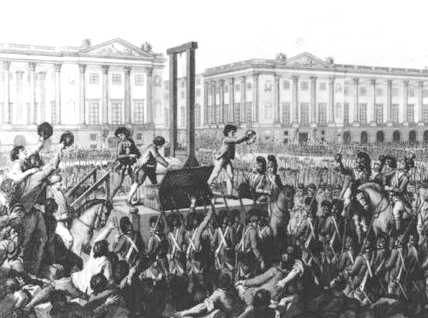
We are looking down the barrel of a French Revolution style economic and political clusterfuck, and Geithner doesn't seem to see the problem correctly. Obama needs to yank the administration of the bailout funds away from DoT and hand it to DoJ.
You rob a 7-11, you go to jail. You steal from every single American taxpayer? You're granted Too Big To Fail status and your buddies at DoT on your speed-dial will go to bat for you.

I'm not posting this to brag that I'm going to be the first one out with the barricades, rather to say that (like pretty much every American) I'm basically OK with other people making shit-tons of money as long as I can live my life undisturbed. And the French Revolution would definitely count as a disturbance. I mean, everybody who isn't already growing their own food is going to suffer in the event of some sort of national breakdown of order. Especially Richie Rich and his credit card. Can't eat plastic. That scenario would not be much fun to live through. I'd rather see the country able to emerge from the crisis more or less intact.
It's not the accumulation of wealth that's problematic per se, it's the concomitant accumulation of power (and its attendant privileges) that's the big problem. I don't hate people for being wealthy, but I certainly do hate the stupid self-righteous arrogant strutting-peacock fucks that have brought the mightiest country on earth to its knees. They have unbalanced the system and are throwing an epic temper tantrum over the country's natural desire to re-balance that system.
I think a lot of people could agree that if the situation gets much more 1930s-ish, the risk of things getting all 1790s-ish in a hurry becomes frightfully high. We are not terribly well equipped to deal with 1930s-style problems at the moment, thanks to the insane Bush-era tax-cuts-plus-two-wars policies that doubled the national debt in eight years, plus they kept cutting interest rates until they approached zero (which helped inflate the real estate bubble) and leaves Obama very little room to maneuver.
* * * * *
Speaking of the 1930s....keep an eye on that unemployment number. Americans, I think, can be kept more or less in line as long as we have something to do. But if unemployment shoots up, in a society that's still built on endless consumerism, eating regularly becomes concern #1 for a lot of people, and hungry people are angry people.
Here's the government's official estimate of the employment situation (warning: PDF). Look at the bottom chart on page 20. U-3 is what is usually reported in the press as "the" unemployment number, but U-6 may actually be closer to reality. (The seasonally adjusted U-3 number is what was recently reported in the press.) For an explanation of these terms, here is the relevant section of the Wikipedia article on unemployment.
Notice how much higher the U-6 number is relative to U-3. 14.8% is a hell of a lot scarier than 8.1%, which is already terrifying.
For comparison's sake (via Wikipedia), here is a nice graph that shows very clearly the sustained unemployment spike in the 30s. On the right side of the graph, we are just barely past the knee in the curve. Any bets on what level the current spike tops out at? Any bets on how long it lasts? (Not me, I don't gamble....)

Two months into his term, this will probably be the single thing that determines Obama's legacy. Seems to me that he needs to fire Geithner immediately, and bring in some sort of Wall St. outsider. [EDIT 3/22: OK, after calming down and thinking and reading about Geithner some more, and watching Obama emphatically back Geithner on Leno, it's pretty clear that Obama probably can't fire Geithner, for obvious political reasons. Firing a Cabinet member this early into the Admin's term would be a huge media feeding frenzy and wouldn't necessarily make anything better. You have to go to war with the Treasury Secretary you have, and not the Treasury Secretary you might wish to have, etc etc.]
We are looking down the barrel of a French Revolution style economic and political clusterfuck, and Geithner doesn't seem to see the problem correctly. Obama needs to yank the administration of the bailout funds away from DoT and hand it to DoJ.
You rob a 7-11, you go to jail. You steal from every single American taxpayer? You're granted Too Big To Fail status and your buddies at DoT on your speed-dial will go to bat for you.

I'm not posting this to brag that I'm going to be the first one out with the barricades, rather to say that (like pretty much every American) I'm basically OK with other people making shit-tons of money as long as I can live my life undisturbed. And the French Revolution would definitely count as a disturbance. I mean, everybody who isn't already growing their own food is going to suffer in the event of some sort of national breakdown of order. Especially Richie Rich and his credit card. Can't eat plastic. That scenario would not be much fun to live through. I'd rather see the country able to emerge from the crisis more or less intact.
It's not the accumulation of wealth that's problematic per se, it's the concomitant accumulation of power (and its attendant privileges) that's the big problem. I don't hate people for being wealthy, but I certainly do hate the stupid self-righteous arrogant strutting-peacock fucks that have brought the mightiest country on earth to its knees. They have unbalanced the system and are throwing an epic temper tantrum over the country's natural desire to re-balance that system.
I think a lot of people could agree that if the situation gets much more 1930s-ish, the risk of things getting all 1790s-ish in a hurry becomes frightfully high. We are not terribly well equipped to deal with 1930s-style problems at the moment, thanks to the insane Bush-era tax-cuts-plus-two-wars policies that doubled the national debt in eight years, plus they kept cutting interest rates until they approached zero (which helped inflate the real estate bubble) and leaves Obama very little room to maneuver.
Speaking of the 1930s....keep an eye on that unemployment number. Americans, I think, can be kept more or less in line as long as we have something to do. But if unemployment shoots up, in a society that's still built on endless consumerism, eating regularly becomes concern #1 for a lot of people, and hungry people are angry people.
Here's the government's official estimate of the employment situation (warning: PDF). Look at the bottom chart on page 20. U-3 is what is usually reported in the press as "the" unemployment number, but U-6 may actually be closer to reality. (The seasonally adjusted U-3 number is what was recently reported in the press.) For an explanation of these terms, here is the relevant section of the Wikipedia article on unemployment.
Notice how much higher the U-6 number is relative to U-3. 14.8% is a hell of a lot scarier than 8.1%, which is already terrifying.
For comparison's sake (via Wikipedia), here is a nice graph that shows very clearly the sustained unemployment spike in the 30s. On the right side of the graph, we are just barely past the knee in the curve. Any bets on what level the current spike tops out at? Any bets on how long it lasts? (Not me, I don't gamble....)

It can't happen here
I'm telling you, my dear
That it can't happen here
Because I been checkin' it out, baby
I checked it out a couple a times, hmmmmmmmm
And I'm telling you
It can't happen here
Oh darling, it's important that you believe me
(bop bop bop bop)
That it can't happen here
Tuesday, March 10, 2009
ladies and gentlemen, i give you the end of a movement
Limbaugh vs. Gingrich.
No points awarded for sumo wrestling metaphors. (Besides, circular firing squad references are so much funnier....)
Wednesday, March 4, 2009
David Foster Wallace
Harper's sent DFW to first the Illinois State Fair and second a Caribbean cruise. The cruise piece is the title article in the collection "A Supposedly Fun Thing I'll Never Do Again" and it's fucking hilarious, if kind of demanding....
Saturday, February 28, 2009
re: AIG
This NYT article (via Atrios) runs down the huge AIG debacle. The first paragraph mentions that losses at AIG are dwarfing pretty much every other company on Wall St., and it's because AIG was an insurance company and not a bank.
It gets worse. Hopefuly, some of these people end up in doing blue-collar jail sentences, but since we never seem to learn from our mistakes, we're apparently doomed to keep repeating them....
As a huge multinational insurance company, with a storied history and a reputation for being extremely well run, A.I.G. had one of the most precious prizes in all of business: an AAA rating, held by no more than a dozen or so companies in the United States. That meant ratings agencies believed its chance of defaulting was just about zero. It also meant it could borrow more cheaply than other companies with lower ratings.
To be sure, most of A.I.G. operated the way it always had, like a normal, regulated insurance company. (Its insurance divisions remain profitable today.) But one division, its “financial practices” unit in London, was filled with go-go financial wizards who devised new and clever ways of taking advantage of Wall Street’s insatiable appetite for mortgage-backed securities. Unlike many of the Wall Street investment banks, A.I.G. didn’t specialize in pooling subprime mortgages into securities. Instead, it sold credit-default swaps.
These exotic instruments acted as a form of insurance for the securities. In effect, A.I.G. was saying if, by some remote chance (ha!) those mortgage-backed securities suffered losses, the company would be on the hook for the losses. And because A.I.G. had that AAA rating, when it sprinkled its holy water over those mortgage-backed securities, suddenly they had AAA ratings too. That was the ratings arbitrage. “It was a way to exploit the triple A rating,” said Robert J. Arvanitis, a former A.I.G. executive who has since become a leading A.I.G. critic.
Why would Wall Street and the banks go for this? Because it shifted the risk of default from themselves to A.I.G., and the AAA rating made the securities much easier to market. What was in it for A.I.G.? Lucrative fees, naturally. But it also saw the fees as risk-free money; surely it would never have to actually pay up. Like everyone else on Wall Street, A.I.G. operated on the belief that the underlying assets — housing — could only go up in price.
That foolhardy belief, in turn, led A.I.G. to commit several other stupid mistakes. When a company insures against, say, floods or earthquakes, it has to put money in reserve in case a flood happens. That’s why, as a rule, insurance companies are usually overcapitalized, with low debt ratios. But because credit-default swaps were not regulated, and were not even categorized as a traditional insurance product, A.I.G. didn’t have to put anything aside for losses. And it didn’t. Its leverage was more akin to an investment bank than an insurance company. So when housing prices started falling, and losses started piling up, it had no way to pay them off. Not understanding the real risk, the company grievously mispriced it.
It gets worse. Hopefuly, some of these people end up in doing blue-collar jail sentences, but since we never seem to learn from our mistakes, we're apparently doomed to keep repeating them....
Thursday, February 26, 2009
liars and thieves
Chris Matthews rebuking Darrell Issa for the childish "Democrat Party" thing is not the most impressive thing about this video. (Although it is impressive. And I will be chuckling over "Republicanistical Party" for a while....)
Issa is best known is the guy who initiated the recall of Gray Davis and installed Arnold as Gov of CA. Issa, of course, wanted the gig for himself.
When Issa says the Bush-era deficits, "even including the war [singular instead of plural sic], " the annual deficit was below $400B, he is narrowly correct (except for 2004 and 2008, which were above $400B). However, the costs of the occupations of Iraq and Afghanistan were never once budgeted for, as Congressman Issa is surely aware; they were paid for off-budget in supplemental appropriations bills, specifically for the purpose of making the reported budget numbers look better. Nothing more, nothing less. Everybody in D.C. knows this. Issa was in Congress when this was going on, and he certainly knows the difference between the annual budget and an appropriations (= spending) bill.
It should not surprise anyone that Barack Obama immediately ended this dishonest practice, and thus his annual budget numbers will be appalling by comparison to Bush's. But every single one of Bush's budgets contained vastly more spending than he claimed, so the comparison is not valid. This, also unsurprisingly, will not stop Obama & Congressional Democrats from being villified by the Know-Nothings on talk radio for one second.
Eventually, America will grow sick of being lied to all the time by people looking after their self-interest, and will hold these people accountable.
Saturday, February 21, 2009
addenda
A few more musings to add to the long post below. (Cause it clearly wasn't long enough!)
Money, of course, is an abstraction. (Gold standard nutters can be quiet in advance, thanks.) Credit is an abstraction of something that was already abstract. Securities and derivatives and all that goobledygook, then, resemble abstraction cubed, or something. The CDO/CDS market was like a couple of parallel funhouse mirrors: distorted and warped, but superficially infinite. As soon as a strong breeze came along, the house of cards collapsed under its own weight, since it was not founded on concrete stuff that actually existed in the real world, or on the work of human hands.
It's sickening, of course, to think that some really abstract, esoteric problem could cause very real, very widespread suffering of such magnitude. Personally, after the events of the last eight years, but especially the last six months, I will never look at the finanical trades (and the people that work in them) the same way again. I have become reinforced in my belief in capitalism, but the operative definition of capitalism has had layers of bullshit scraped away from it.
Labor and capital need each other very badly. When wealth is transferred from the poor to the wealthy, everyone becomes a supplier and nobody is a demander. I didn't take Econ 101, but I assume that means deflation. If you've got a small group of wealthy folks, a shrinking group of people that make stuff, and a vast underclass of workers with no work, you get pretty much where we are now. And since the middle class is increasingly mailing the keys to their house to the bank, it's obvious that wealthy folks are blind to the problems of getting everything you wish for. Just like predators can overhunt the food that sustains them, so can capital take so much from its employees that no one can afford to buy their stuff any longer.
The opposite problem (when labor dominates capital) is why genuinely communist countries never seem to be very stable. (FWIW the collapse of the Soviet Union was not due to this, it was due to many things, but I think chief among them was its unsustainably corrupt system of government rather than its economic structure per se.) So the recognition of labor and capital as yin and yang seems to me to be a crucial part of any economic philosophy.
So, to me, this post-2008 capitalism is going to have to be re-founded on the idea that markets are the best way to distribute wealth, up to a point, and the government has to be willing to step in and referee when needed. Proper, rational regulation is the only thing that separates functioning capitalism from anarchy. (Madison famously said, "if men were angels, no government would be necessary.")
Paramount to this is keeping nakedly corrupt assholes away from the government.
Money, of course, is an abstraction. (Gold standard nutters can be quiet in advance, thanks.) Credit is an abstraction of something that was already abstract. Securities and derivatives and all that goobledygook, then, resemble abstraction cubed, or something. The CDO/CDS market was like a couple of parallel funhouse mirrors: distorted and warped, but superficially infinite. As soon as a strong breeze came along, the house of cards collapsed under its own weight, since it was not founded on concrete stuff that actually existed in the real world, or on the work of human hands.
It's sickening, of course, to think that some really abstract, esoteric problem could cause very real, very widespread suffering of such magnitude. Personally, after the events of the last eight years, but especially the last six months, I will never look at the finanical trades (and the people that work in them) the same way again. I have become reinforced in my belief in capitalism, but the operative definition of capitalism has had layers of bullshit scraped away from it.
Labor and capital need each other very badly. When wealth is transferred from the poor to the wealthy, everyone becomes a supplier and nobody is a demander. I didn't take Econ 101, but I assume that means deflation. If you've got a small group of wealthy folks, a shrinking group of people that make stuff, and a vast underclass of workers with no work, you get pretty much where we are now. And since the middle class is increasingly mailing the keys to their house to the bank, it's obvious that wealthy folks are blind to the problems of getting everything you wish for. Just like predators can overhunt the food that sustains them, so can capital take so much from its employees that no one can afford to buy their stuff any longer.
The opposite problem (when labor dominates capital) is why genuinely communist countries never seem to be very stable. (FWIW the collapse of the Soviet Union was not due to this, it was due to many things, but I think chief among them was its unsustainably corrupt system of government rather than its economic structure per se.) So the recognition of labor and capital as yin and yang seems to me to be a crucial part of any economic philosophy.
So, to me, this post-2008 capitalism is going to have to be re-founded on the idea that markets are the best way to distribute wealth, up to a point, and the government has to be willing to step in and referee when needed. Proper, rational regulation is the only thing that separates functioning capitalism from anarchy. (Madison famously said, "if men were angels, no government would be necessary.")
Paramount to this is keeping nakedly corrupt assholes away from the government.
the shape of things to come
Up to 120,000 protest in recession-hit Ireland
DUBLIN (AFP)--Up to 120,000 protesters brought Dublin city centre to a standstill on Saturday over government austerity measures aimed at stabilising the once high-flying economy now wracked by recession.
(...)
Organised by the Irish Congress of Trade Unions (ICTU) and featuring teachers, police, civil servants and others, the Irish protest was the "first step in a rolling campaign of action," ICTU general secretary David Begg said.
Police put the number of protesters at up to 120,000.
Marchers are particularly opposed to a pension levy on some 350,000 public servants which is designed to save about 1.4 billion euros (1.8 billion dollars) this year.
Some perspective on the numbers in that piece....
Dublin metro is about 1.6M people, a little smaller than Kansas City (~1.9M). Imagine ~150K (police estimate!) in the streets of downtown KC.
I don't have an informed opinion about the particular tax that sparked the protest, but dividing $1.8B by 850,000 gives you a figure of just over $2,100 per person.
I like the guy's sign in the picture: TAX THE GREEDY, NOT THE NEEDY.
France offers funds to Guadeloupe
Strike leaders in Guadeloupe and Martinique have agreed to resume talks after an offer from the French president aimed at ending weeks of protests.
The French Caribbean territories of Martinique and Guadeloupe, promote an image of tropical peace and luxury - but in the past few weeks that image of the French Antilles has been tarnished by strikes and violence that have left one person dead and the economy in tatters.
Guadeloupe may be a tourist destination, but it suffers from the highest unemployment rates and most expensive living costs in France.
Latvia in turmoil as premier resigns
Pressure has mounted on Mr Godmanis to resign after demonstrators rioted against the government in Riga last month. The centre-right coalition was already under fire for corruption and arrogance and lost any remaining credibility last year after the once-booming economy plunged into recession.
Euro Reaches Three-Month Low on Eastern Europe Banking Concern
Feb. 21 (Bloomberg) -- The euro reached the lowest level against the dollar in three months on speculation financial turmoil in eastern Europe may deepen the recession in the 16 nations that use the currency.
The yen fell for a fourth week against the dollar and dropped versus the euro as the biggest contraction in Japan’s economy since the 1974 oil shock eroded demand for the currency as a haven from the global recession. Mexico’s peso tumbled to a record low versus the dollar after the central bank cut the target lending rate less than economists forecast.
"We are now moving very specifically to euro concerns," said Simon Derrick, chief currency strategist in London at Bank of New York Mellon Corp., in an interview on Bloomberg Television. "The idea that we could see another 10 percent drop in the euro makes perfect sense to me."
Iceland's center-left party to lead new government
REYKJAVIK, Iceland (AP)--Iceland's center-left Social Democratic Alliance Party was chosen Tuesday to form a new government with the Left-Green movement following the collapse of the conservative government amid deep economic troubles.
President Olafur Ragnar Grimsson made the decision after Prime Minister Geir Haarde, who had led the island nation since 2006, was toppled [1/26/09] by angry protests over the country's slide into economic ruin.
Europe Getting Hit On All Sides
European stocks tumbled sharply on Friday, as announcements from miner Anglo American, car maker Saab and two French building firms reinforced the sense of gloom pervading the markets. Adding to the pressure were fears about the state of Eastern European economies continued, as the entire government of Latvia resigned and the country tumbled into a sharp recession.
I had a hard time excerpting things from the following article. It just kept getting crazier and there is plenty I did not include here:
Bank bail-out 'could send national debt soaring by £1.5 trillion'
The government's rescue of some of Britain's biggest banks will more than double the national debt at a stroke after government statisticians decided to classify Lloyds and Royal Bank of Scotland as public corporations. Their liabilities--up to £1.5tn--will be added to the taxpayer's balance sheet.
That could push the country's debt levels up to 150% of national income, from a three-decade high of 48% now. The public sector net debt has already been swollen by £90bn of Northern Rock liabilities and, as of yesterday, £50bn of Bradford & Bingley's liabilities. But the two latest additions, which the ONS estimates could total between £1tn and £1.5tn, would dwarf those.
It was already widely expected that RBS's liabilities would come onto the public balance sheet since it is now 70% owned by the taxpayer but it is a surprise that Lloyds, which recently swallowed Halifax Bank of Scotland, has been classified as a public corporation given that it is only 43% owned by the state.
(...)
The other piece of bad news was that tumbling income tax, corporation tax and VAT revenues in January caused the public deficit for the first 10 months of the fiscal year 2008/09 to blow out to £67bn from £23bn a year ago.
The IFS said that meant the public deficit for this year to April could run up to £87bn. Just over two months ago, in the pre-budget report, the chancellor, Alistair Darling, estimated a shortfall of £78bn for this year.
Public net debt has already hit a record 47.8% of GDP, today's figures showed. The ONS also reported that the government finances worsened dramatically in January--the biggest tax-raising month of the year.
Germany, France May Face Bailout of Nations, Not Just Banks
Feb. 18 (Bloomberg) -- Germany and France may be forced to contemplate the bailout of entire nations rather than just individual banks as European government budgets buckle under the weight of recession.
German Finance Minister Peer Steinbrueck became the first senior policy maker to broach the topic this week, saying some of the 16 euro nations are "getting into difficulties" and may need help. French officials are also concerned about market tensions as the cost of insuring Irish, Greek and Spanish debt against default rises to records and bond spreads widen.
The nightmare for Angela Merkel and Nicolas Sarkozy is that widening deficits will prompt investors to shun the debt of some countries, sparking a region-wide crisis. While few investors are yet forecasting any defaults, the mere risk of it may prompt the bloc’s two richest economies to ignore the European Central Bank and announce their willingness to come to the rescue.
"When push comes to shove Germany, France, the larger players will bail out those smaller peripheral players," said Alex Allen, chief investment officer of Eddington Capital Management. "You can’t let one part of the system fail because it leads to failure of the whole system.'
Not much to say after that but ZOMG
Roubini Says Europe Bank Risks Becoming ‘More Severe’
Feb. 20 (Bloomberg) -- Europe’s banking system faces growing risks because of losses in the region’s emerging markets, and the crisis may require a region-wide rescue effort, said New York University economist Nouriel Roubini.
"The banking problem in Europe is becoming more severe," Roubini said in a Bloomberg Television interview. "You have a series of countries that are really in trouble," Roubini said, citing Latvia, Estonia, Lithuania, Hungary, Belarus and Ukraine.
German and French officials this week expressed concern about a slide in investor confidence in smaller European economies. The cost of insuring Irish, Greek and Spanish debt against default has climbed to records, and mounting losses in eastern Europe among Austrian banks sent that nation’s bond-yield premiums to an unprecedented level.
Re: Roubini--the guy earned the name "Dr. Doom" because he made negative predictions about the current crisis several years ago that were derided at the time but--whoops!--are now coming true.
B-b-b-but Nobody Could Have Foreseen....
So what's the upshot of all this?
The economic situation in Europe is not looking any prettier than it is in the States at the moment. In some of the smaller nations that were still in the middle of decades-long economic reforms (in particular, former Soviet bloc countries converting to capitalism--some system, eh?), we are seeing political realignment and/or civil unrest.
Some other Western European nations are either at risk of defaulting (Ireland) or already have defaulted (Iceland) after having had booming economies.
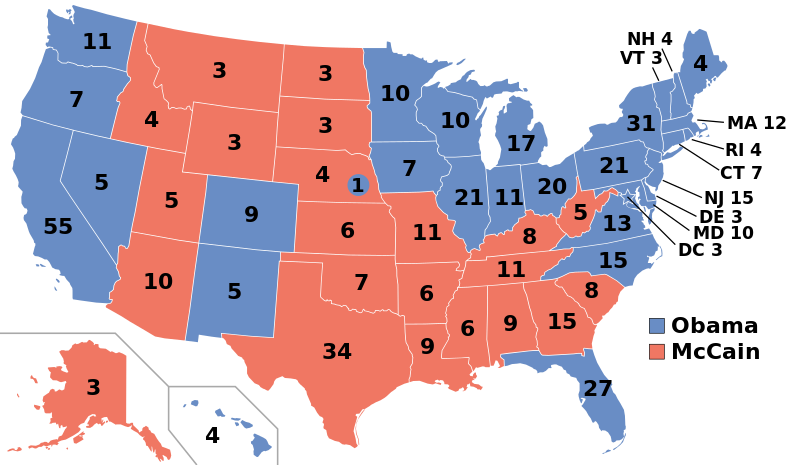
If anybody in the US is thinking It Can't Happen Here, think again*. It's looking that nationalization of banks is a foregone conclusion, and we just haven't done it yet. Roubini has pointed out that bank nationalization is probably only feasible if it all happens at once, rather than piecemeal, bank by bank. (Let that sink in for a minute.)
Vanishingly few people from left to right in America (certainly no one at all in a position of power) are actually advocating permanent government control of the banking industry. In fact I think you'd find very few takers indeed who would say that gov't control of banks is a good thing at all. But events seem to be outrunning everybody's ideologies (again from left to right); thus the emerging consensus (once again pointed out very early on by Roubini) seems to be that the only pragmatic thing to do is to follow the precedent the Swedish gov't set in the 90s when faced with a similar, if much smaller-scale, set of crises that the entire global financial system is now staring at.
Essentially, the solution was to nationalize the banks; fire the greedy goddamn geniuses running the places; sell off worthless assets at their current market value (i.e. pennies on the dollar, since they were purchased at the top of a way over-inflated market); restore the balance sheets to something resembling stability; and then (this is obviously the key): sell the banks back to the private sector.
Obviously, what Team Obama is wrestling with is substantially greater in scope than the Swedish crisis. Could it work? Who knows. But it's reasonable to think that it actually could. There's a historical precedent for it, and it recognizes insolvency rather than illiquidity is the problem. In English, that means the banks aren't merely short of cash, they're fucking broke. And, in capitalism, what happens when businesses go broke? They get bought up by other businesses, or their assets go to the bank. But what happens when the banks are broke?
Whatever the correct answer to that question is, government intervention clearly has to be mentioned in it somewhere--delicate right-wing sensibilities about what is and is not capitalism or socialism be damned. Welcome to the 21st Century. Buy the ticket, take the ride.
* Come to think of it, we just had a major political realignment here already. Here's hoping we can skip the riots part.
(P.S. Some of these links courtesy of here.)
Monday, February 2, 2009
new board
The ol Mackie 1604, alas, is not as reliable as it once was. I saw a 24 channel Allen & Heath System 8 put up on the local Craigslist for....well, not quite peanuts exactly, but it was a pretty good deal. The guy said a friend of his who worked for FedEx managed to get it from some place, and thru his job was able to transport it from whereever it came from to KC. Then that guy passed away, and the guy I bought it from (a friend of the deceased) said the last owner's family had given it to him to more or less get rid of. Serial # = 4144, which makes it a MkIII, probably built 1987-1988 or so.
Pretty much everything seems to work. Some of the knobs and fader caps are busted off, and it's missing some case screws, but that's strictly cosmetic; I get some noise when I adjust some of the input trim pots, but it's not too overwhelming; the VUs don't light up and some of them (although not 1/2 and the master L/R) don't seem to work at all; and some of the more arcane jacks on the rear panel don't seem to want to function either. (I'd love it if I could get the cue/monitor outs to work, for example....)
But all in all, it sounds fairly clean and well-taken care of, even if it is a little beat-up looking. Here it is....

So I went out to Olathe to look at it....I didn't have the full amount at the time anyway, so I figured I could pay half and take the power supply. Instead, he told me to take the board and come back for the PSU! Luckily my neighbor was home, and he helped me drag this heavy sonofabitch into the basement. I reckon the board weighs north of 80 lbs, maybe 100.
So I finally got the power supply about a week ago. The seller said he had gone to the trouble of ordering the PSU directly from A&H before he sold it, which would indeed make the damn thing a lot easier to sell. The literature refers to a different model # than this one, so the seller was definitely telling the truth about getting a brand new PSU.

What sold me were 1) the direct outs on every input channel....

....and 2) the weird group output/tape return section.

(These jacks correspond to the fader section on the far right hand side on the front of the mixer.)
For some reason, the group routing buttons on each input channel (left side of mixer) and the returns (outputs) from tape go to the same faders, and you switch between the two functions with a button. The bus outputs are male XLR, which I find bizarre, but was probably really useful for anybody using an 8-track tape deck, which is what this was obviously designed for. Since this thing has only three (mono!) auxes, and my headphone amp is eating up two of them, I really need to get those bus outs working.
What has me excited is that since I record to a Delta 1010LT, I can connect all 8 outputs to my 8 tape returns, which is after all what they're for. When I had the Mackie hooked up, I had to either run the outputs from the Delta to the patchbay or not use them at all. I mostly didn't use them. I don't really have much outboard gear to speak of, so I guess it's not that big a deal. But I'll still be able to create different headphone mixes just by adjusting the aux 1-2 sends on the tape returns (instead of having to mute things on the computer).
And if (when, really) I get a 2nd Delta, I'll still be able to route all 8 of that card's outputs to tape returns 9-16, giving me even more flexibility. This will save me a lot of repatching. And if for whatever strange reason I need to do something drastic with Delta outputs 13-14, I can just stroll to the back of the A&H and move the cable over to a leftover input channel (cause I'll always have several spare input channels, which is a good thing), push one button to send it to a group fader, and then I can zip it anywhere in the room from the patchbay.
Or I could just get insert cables and wire all of those to the patchbay.
Today's lesson: jacks are a good thing.
Pretty much everything seems to work. Some of the knobs and fader caps are busted off, and it's missing some case screws, but that's strictly cosmetic; I get some noise when I adjust some of the input trim pots, but it's not too overwhelming; the VUs don't light up and some of them (although not 1/2 and the master L/R) don't seem to work at all; and some of the more arcane jacks on the rear panel don't seem to want to function either. (I'd love it if I could get the cue/monitor outs to work, for example....)
But all in all, it sounds fairly clean and well-taken care of, even if it is a little beat-up looking. Here it is....

So I went out to Olathe to look at it....I didn't have the full amount at the time anyway, so I figured I could pay half and take the power supply. Instead, he told me to take the board and come back for the PSU! Luckily my neighbor was home, and he helped me drag this heavy sonofabitch into the basement. I reckon the board weighs north of 80 lbs, maybe 100.
So I finally got the power supply about a week ago. The seller said he had gone to the trouble of ordering the PSU directly from A&H before he sold it, which would indeed make the damn thing a lot easier to sell. The literature refers to a different model # than this one, so the seller was definitely telling the truth about getting a brand new PSU.

What sold me were 1) the direct outs on every input channel....

....and 2) the weird group output/tape return section.

(These jacks correspond to the fader section on the far right hand side on the front of the mixer.)
For some reason, the group routing buttons on each input channel (left side of mixer) and the returns (outputs) from tape go to the same faders, and you switch between the two functions with a button. The bus outputs are male XLR, which I find bizarre, but was probably really useful for anybody using an 8-track tape deck, which is what this was obviously designed for. Since this thing has only three (mono!) auxes, and my headphone amp is eating up two of them, I really need to get those bus outs working.
What has me excited is that since I record to a Delta 1010LT, I can connect all 8 outputs to my 8 tape returns, which is after all what they're for. When I had the Mackie hooked up, I had to either run the outputs from the Delta to the patchbay or not use them at all. I mostly didn't use them. I don't really have much outboard gear to speak of, so I guess it's not that big a deal. But I'll still be able to create different headphone mixes just by adjusting the aux 1-2 sends on the tape returns (instead of having to mute things on the computer).
And if (when, really) I get a 2nd Delta, I'll still be able to route all 8 of that card's outputs to tape returns 9-16, giving me even more flexibility. This will save me a lot of repatching. And if for whatever strange reason I need to do something drastic with Delta outputs 13-14, I can just stroll to the back of the A&H and move the cable over to a leftover input channel (cause I'll always have several spare input channels, which is a good thing), push one button to send it to a group fader, and then I can zip it anywhere in the room from the patchbay.
Or I could just get insert cables and wire all of those to the patchbay.
Today's lesson: jacks are a good thing.
Friday, January 30, 2009
sometimes the jokes write themselves
The Iraqi reporter who threw his shoes at Bush in Baghdad has become a folk hero in the Arab world. Turns out a sculptor was inspired to build a giant copper shoe monument at an orphanage in Tikrit (Saddam's hometown), with the assistance of the orphans. The statue was unveiled Thursday.
By Friday, Iraqi authorities made them take it down.
(Maximum Irony bonus: Bush said at the time, "Here I am, getting ready to answer questions from a free press [sic] in a democratic [sic] Iraq [sic], and a guy stands up and throws his shoe. And it was bizarre, and it was an interesting way for a person to express himself [sic].")
By Friday, Iraqi authorities made them take it down.
(Maximum Irony bonus: Bush said at the time, "Here I am, getting ready to answer questions from a free press [sic] in a democratic [sic] Iraq [sic], and a guy stands up and throws his shoe. And it was bizarre, and it was an interesting way for a person to express himself [sic].")
Tuesday, January 20, 2009
PIVOT
long valley of history stretches out behind,
long vista of humanity stretches out before,
from the Capitol Steps to the Washington Monument.
quite a view from this Mountaintop, isn't it?
colonization,
Middle Passage,
servitude,
Revolution,
Manifest Destiny,
Civil War,
domestic terrorism and oppression,
World War,
Depression and the bowl,
World War again,
Vietnam,
Selma Birmingham Philadelphia Chicago,
assassinations,
the Wall,
the Towers,
Afghanistan,
Iraq,
Katrina,
Depression again,
and here we are,
a bend in the road,
a switchback as it goes down on the far side of the mountain.
quite a ride.
never thought i'd live to see the day.
but here we are.
roll up them sleeves
we've got a lot of work to do.
long vista of humanity stretches out before,
from the Capitol Steps to the Washington Monument.
quite a view from this Mountaintop, isn't it?
colonization,
Middle Passage,
servitude,
Revolution,
Manifest Destiny,
Civil War,
domestic terrorism and oppression,
World War,
Depression and the bowl,
World War again,
Vietnam,
Selma Birmingham Philadelphia Chicago,
assassinations,
the Wall,
the Towers,
Afghanistan,
Iraq,
Katrina,
Depression again,
and here we are,
a bend in the road,
a switchback as it goes down on the far side of the mountain.
quite a ride.
never thought i'd live to see the day.
but here we are.
roll up them sleeves
we've got a lot of work to do.
Subscribe to:
Posts (Atom)